Mechanistic Framework for Shift Factor Development in Cemented Pavement Materials
Cemented pavement materials (CPMs), also known as cement-stabilised pavement materials (CSPMs) or cement-treated bases (CTBs), are mixtures of granular aggregates, water and cementitious binders such as Portland cement, lime or other chemical agents (Austroads, 2017).
This article was featured on NTRO on April 1, 2026
1. Background
Cemented pavement materials (CPMs), also known as cement-stabilised pavement materials (CSPMs) or cement-treated bases (CTBs), are mixtures of granular aggregates, water and cementitious binders such as Portland cement, lime or other chemical agents (Austroads, 2017). Widely used in road construction and rehabilitation, CPMs are valued for their cost-effectiveness and ability to enhance pavement strength. However, like all structural pavement layers, CPMs deteriorate over time, primarily due to fatigue damage caused by repeated vehicle loading. Fatigue cracks typically initiate at the bottom of the CPM layer and propagate upward, progressively degrading the pavement’s load-carrying capacity. To evaluate and predict fatigue performance, laboratory tests, such as unconfined compressive strength (UCS), indirect tensile (IDT) and four-point bending (4PB) tests, are commonly used to assess mechanical properties and fatigue life (Austroads, 2020; Pai et al., 2022; Richard, 2012; Zhang et al., 2022). Despite their usefulness, laboratory tests cannot fully replicate the complex conditions experienced by CPMs in the field. Field conditions often differ significantly from laboratory settings in terms of boundary constraints, stress and strain states, loading modes, and variations in material properties, among other factors. As a result, predictions based solely on lab data often fail to reflect actual field performance.
To bridge this gap, shift factors (SFs) – numerical adjustments to laboratory results – are used to estimate field fatigue life. SFs are central to mechanistic-empirical design standards (Austroads, 2017; SANRAL, 2013) and remain a focus of ongoing research. However, SF values reported in the literature vary widely, largely due to the inconsistency in experimental methods and fatigue failure definitions (Al-Qadi & Nassar, 2003; Ma et al., 2019; Mateos et al., 2011; Prowell, 2010). Laboratory fatigue failure is often defined by modulus reduction, while field fatigue failure is typically identified by surface cracking. Furthermore, differences between laboratory-prepared and in-situ materials add to this variability (Austroads, 2008b). To address these issues, a more robust and transparent approach is needed – one that applies consistent failure criteria across scales and captures the mechanisms driving the shift in performance between them. Numerical modelling offers a promising solution by simulating key fatigue behaviours, including modulus reduction, fatigue life and crack growth, while accounting for failure mechanisms, boundary and loading conditions. Compared to purely experimental approaches, numerical methods provide greater certainty and deeper insights. Building on these advantages, this study introduces a mechanistic methodology for developing lab-to-field shift factors. By combining rigorous fatigue modelling with a consistent failure criterion (i.e., modulus reduction), this framework offers a more reliable means of predicting the fatigue performance of CPMs in the field (Le et al., 2024). To ensure accessibility for a broad audience, this paper focuses on the motivation, key findings and practical implications of the study, rather than technical details, aiming to inform both decision-makers and technical professionals interested in implementing these insights.
2. A Mechanistic Approach to Developing Lab-to-Field Shift Factors
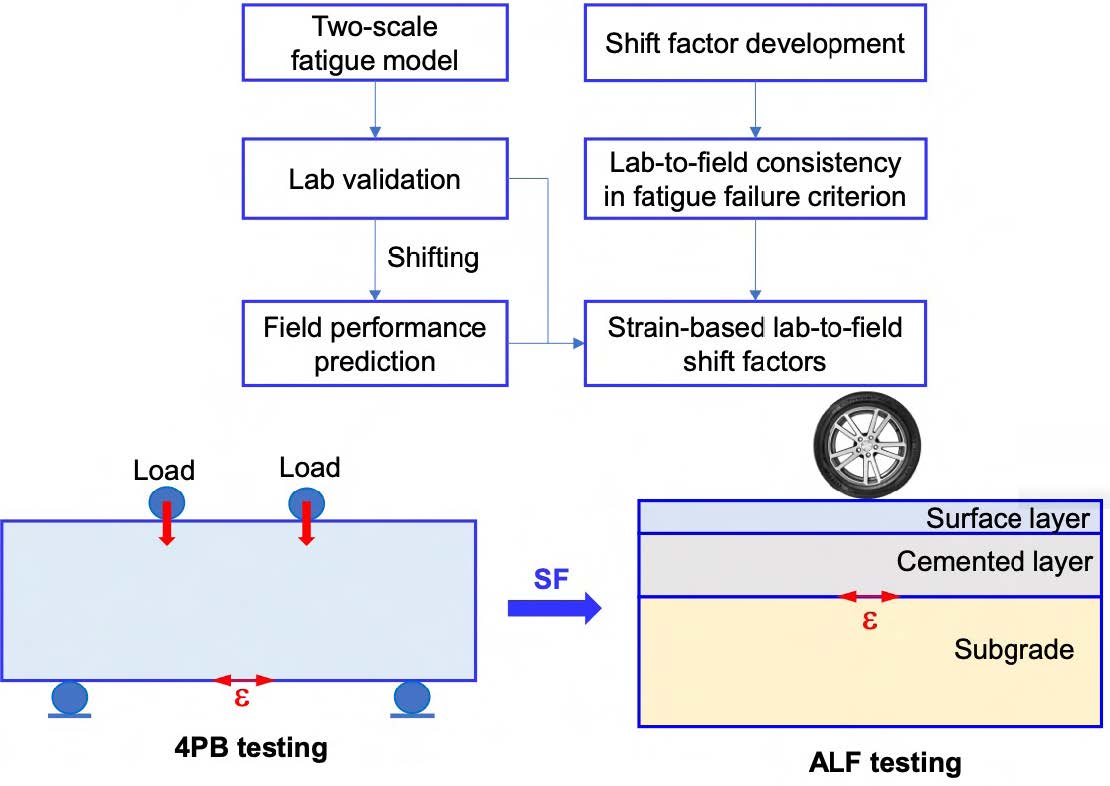
This section outlines a mechanistic methodology that links laboratory and field fatigue performance through fatigue damage modelling and a consistent failure criterion, as illustrated in Figure 1. The approach begins with a two-scale fatigue model (Le et al., 2023), calibrated against four-point bending (4PB) test data on Australian CPMs – namely, siltstone and hornfels (Austroads, 2008c), as described in Section 2.1. The model captures key fatigue behaviours observed in the lab, including modulus reduction curves and fatigue crack growth, offering a reliable basis for predicting field performance (Le et al., 2024). After validation with laboratory tests, the model is applied to simulate in-situ performance using full-scale accelerated loading facility (ALF) test data (Austroads, 2008a, 2008b), detailed in Section 2.2. Crucially, the same fatigue failure criterion (modulus reduction) is applied consistently at both scales, ensuring meaningful comparisons. By explicitly accounting for differences in strain states and boundary conditions between laboratory and field conditions, the methodology quantifies the intrinsic shift in fatigue performance without entirely relying on empirical adjustments, as discussed in Section 3. This provides mechanism-based shift factors that are both reliable and practical for engineering applications.
Figure 1: Proposed methodology for SF development (Le et al., 2024).
2.1 Validation of CPMs’ Fatigue Characteristics at Laboratory Testing
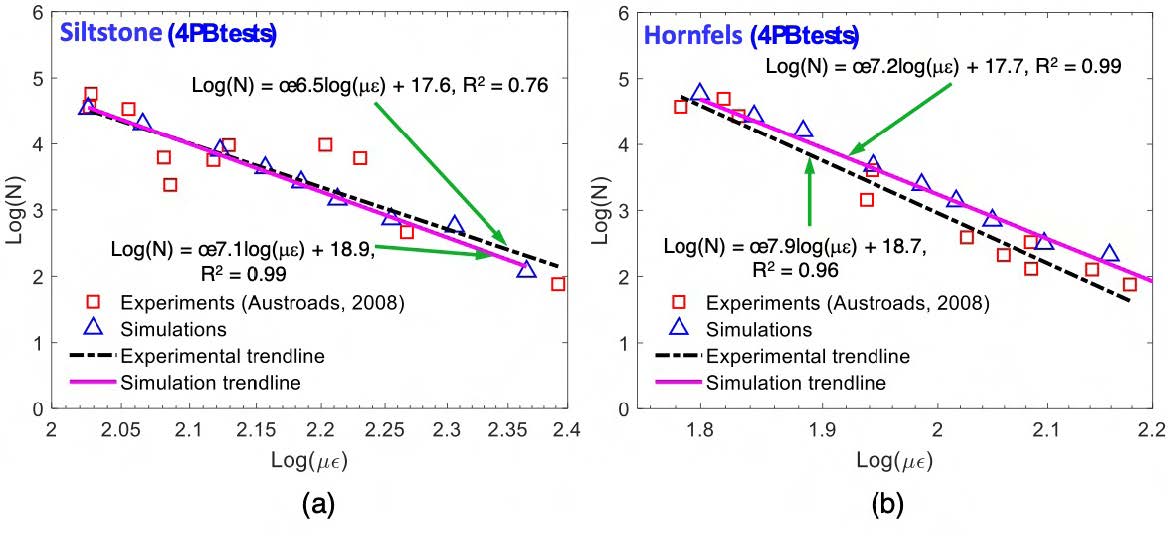
This section focuses on evaluating the fatigue behaviour of CPMs in the laboratory using the developed fatigue model developed by Le et al. (2023). The model was implemented in the commercial software ABAQUS and applied to simulate two-dimensional 4PB tests on two typical CPMs: siltstone and hornfels (Austroads, 2008c). To assess the model’s ability to predict fatigue performance under different stress levels accurately, simulation results were compared against experimental data, as shown in Figure 2. The comparison examines the relationship between the initial micro-tensile strain – measured at the mid-bottom of the beam (see Figure 1) – and the corresponding fatigue life, expressed as S-Nf curves. Here, fatigue life Nf is defined as the number of load cycles required for the material’s modulus to decrease by 50%, following (Austroads, 2014a). The results show that the model successfully captures the strong influence of stress level on fatigue life, demonstrated by the close agreement between the simulation trend line and the experimental observations.
Figure 2: Comparison of initial micro-tensile tensile strain versus fatigue lives (S−NfS−Nf curves) between simulation and experiments: (a) Siltstone materials; (b) Hornfels materials (Le et al., 2024).
2.2 Prediction of CPMs’ Fatigue Characteristic at Full-Scale Testing
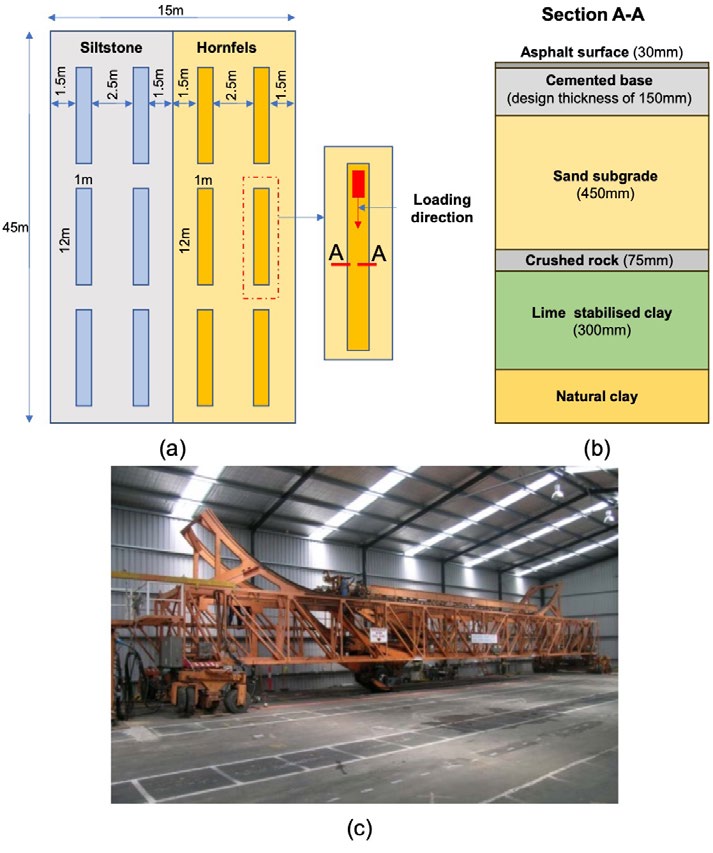
Based on the calibrated fatigue model parameters presented in Section 2.1, this section predicts the full-scale fatigue performance of CPMs. To do so, two-dimensional simulations were conducted, replicating full-scale testing under ALF loading conditions (Austroads, 2008b). Notably, the CPMs used in the 4PB laboratory tests were identical to those used in the ALF experiments (Austroads, 2008c). The experimental layout of the ALF tests, conducted by the former Australian Road Research Board (ARRB, now the National Transport Research Organisation, NTRO) (Austroads, 2008b), is shown in Figure 3. Two pavement sections were constructed using different CPMs: siltstone and hornfels. Each experimental layout consisted of 7.5 m wide by 45 m long cemented pavement sections, allowing for up to six ALF experiments per CPM type. Before loading, the hornfels and siltstone layers were cured for four and seven months, respectively. The test sections were subjected to continuous rolling loads using a dual-wheel half-axle, with applied loads ranging from 40 to 80 kN. All experiments were conducted indoors under dry conditions to eliminate environmental influences.
Figure 3: ALF tests: (a) Experiment layout; (b) Test pavement structure (Le et al., 2024); (c) The Australian ALF operating indoors at Dandenong, Victoria (Austroads, 2008b)
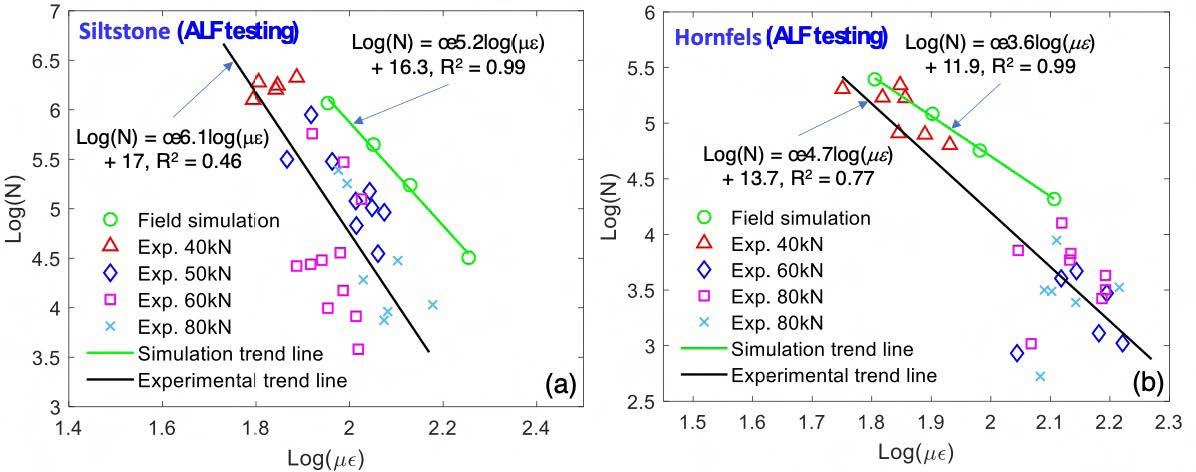
To evaluate the model’s quantitative performance, S-Nf curves derived from both the simulations and experiments are compared in Figure 4. The comparison shows a consistent trend, with simulated fatigue lives falling within the range of the experimental data. However, the simulation trend line slightly overestimates the initial strain relative to the experimental observations. This discrepancy is likely due to differences in how the initial tensile strain was calculated. The experimental results assume an elastic pavement structure under axisymmetric conditions, whereas the simulations compute the initial strain under plane stress conditions. Additionally, differences in the assumed modulus and thickness of pavement layers in the ARRB’s elastic modelling, compared to the calibrated subgrade modulus in the simulations, may also contribute to the observed variation.
Figure 4: Comparison of initial micro-tensile strain versus fatigue lives (S-Nf curves) between field-scale simulation and ALF experiments for: (a) Siltstone materials; (b) Hornfels materials (Le et al., 2024).
3. Fatigue Shift Factor Development and Implications for Design
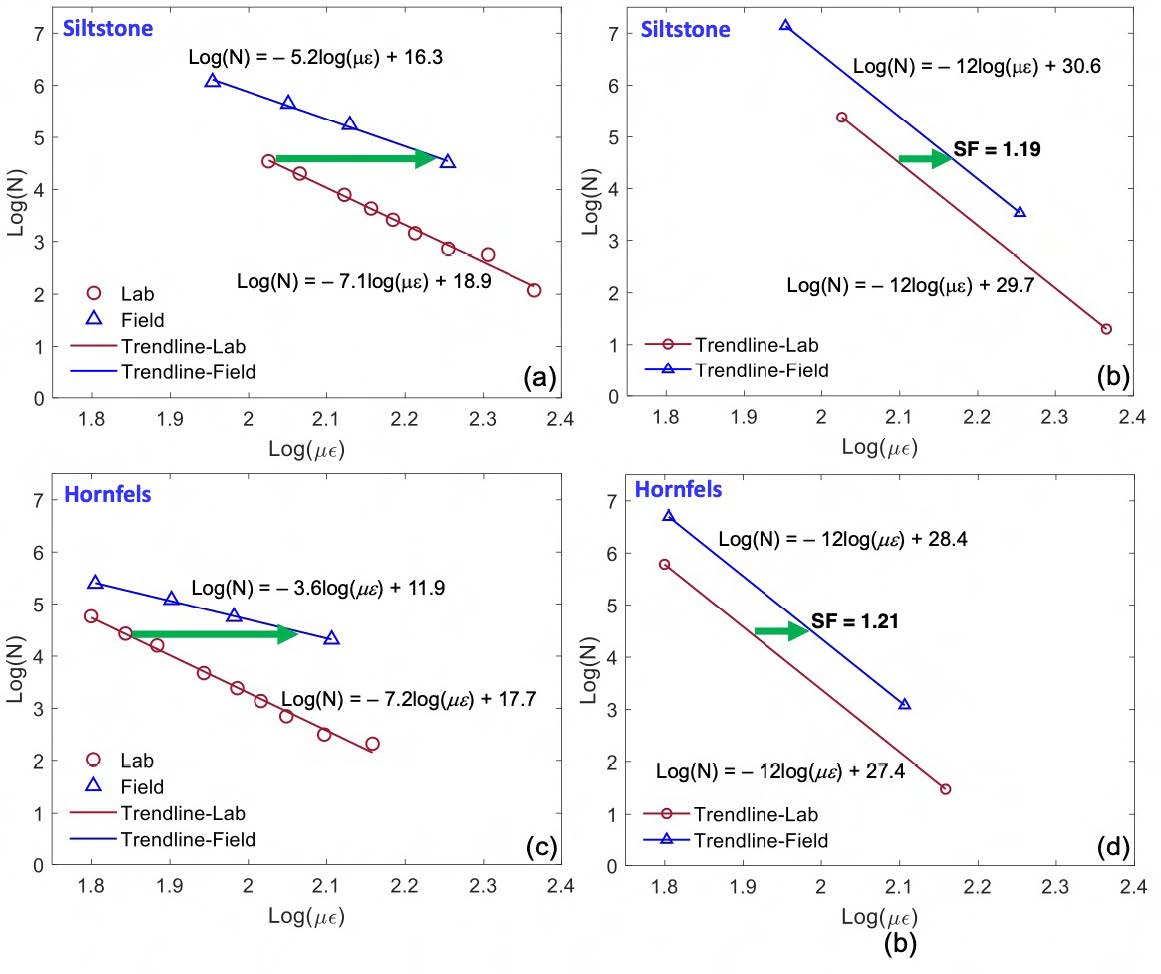
The primary goal of this study is to bridge the gap between laboratory and field fatigue performance of CPMs by deriving reliable shift factors (SFs). To this end, S-Nf curves from simulations of both laboratory-scale (4PB tests) and field-scale (ALF tests) fatigue performance are plotted on a logarithmic scale in Figure 5a and Figure 5c. As shown, a clear shift appears in the log(Nf)–log(με) relationship when moving from laboratory to field conditions, mainly due to differences in boundary conditions and resulting failure mechanisms (Le et al., 2024).
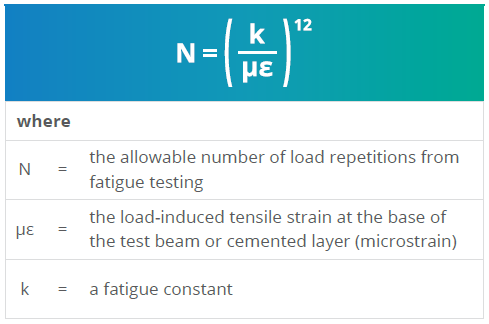
Austroads (2014b, 2017) has long recommended a strain-based fatigue equation, proven effective in both laboratory and accelerated loading data and forming the basis of their design procedures for decades. This equation is expressed as:
The strain damage exponent (SDE) of 12 in Equation 1 represents an average value derived from a large dataset of laboratory fatigue tests on various CPMs and is adopted in this study. Using this SDE, mechanism-based shift factors (M-SFs) of 1.19 and 1.21 were determined for siltstone and hornfels, respectively, as shown in Figure 5b and Figure 5d. These SFs are the outcome of a rigorous fatigue modelling approach, validated comprehensively at the laboratory scale and shown to predict field performance reasonably. Importantly, applying a consistent fatigue failure criterion across laboratory and field conditions makes these M-SFs more reliable and distinguishes them from previously proposed SFs for CPMs. It is also worth noting that the M-SFs in this study are derived within the strain-fatigue life space, explicitly addressing the strain differences between laboratory and field conditions (see Figure 1). The resulting M-SFs are lower than the strain-based SF of 1.9 recommended by (Austroads, 2014b), which was derived empirically from Mulgrave ALF tests and based on a threefold reduction in modulus (as detailed in Sections 3.1 and 7.4 of Austroads (2014b)). That original SF of 1.9 was later adjusted to 1.8, reflecting a revised definition of in-service fatigue life as one-fifth, rather than one-half, of the initial modulus. In practice, this empirical SF converts laboratory results – obtained from well-cured beams with minimal micro-cracking and high modulus – into design models using a design modulus equal to one-third of the 90-day laboratory value. In contrast, the M-SFs presented here aim to capture the intrinsic shift in fatigue performance from laboratory to field scale. They are derived from simulations calibrated with laboratory fatigue relationships reported in (Austroads, 2008c), which were influenced by micro-cracking due to disruptions during moist curing. Therefore, the M-SFs of 1.19 and 1.21 for siltstone and hornfels, respectively, should be interpreted as applicable to weaker field areas that may have experienced some micro-cracking before loading.
Figure 5: Shifting in strain and fatigue lives from lab to field scale: (a) Lab-to-field shifting for hornfels; (b) Lab-to-field SF for hornfels using SDE of 12 (Le et al., 2024).
4. Conclusion and Future Works
This study demonstrates that a mechanistic, modelling-based methodology can reasonably develop the translation of laboratory fatigue test results into field performance predictions for CPMs. By combining laboratory calibration, field validation and a consistent failure criterion, the approach produces reliable and practical shift factors. The strain-based lab-to-field shift factors derived here – 1.19 for siltstone and 1.21 for hornfels – represent the intrinsic mechanical differences between laboratory and field conditions rather than traditional empirical factors. This enhances confidence in fatigue life predictions and supports more informed pavement design and maintenance decisions.
Although developed for CPMs, the methodology is adaptable to other pavement materials and conditions, offering a pathway toward more resilient and cost-effective road infrastructure. Future research should aim to develop more generalised shift factors by accounting for additional influences, such as moving loads, traffic wander, and increasingly extreme environmental conditions, which differ markedly between laboratory and field settings. Finally, developing methods to integrate individual shift factors – each representing different contributing mechanisms – into a single and comprehensive factor, remains an important area for further investigation.
5. Acknowledgements
This research work is part of a research project (Project No IH18.02.4) sponsored by the SPARC Hub (https:// sparchub.org.au) at the Department of Civil and Environmental Engineering, Monash University, funded by the Australian Research Council (ARC) Industrial Transformation Research Hub (ITRH) Scheme (Project ID: IH180100010). The financial support from Monash International Scholarship (Le) and the Australian Research Council via Future Fellow Project FT200100884 (Bui) is also gratefully acknowledged. Part of this research was undertaken with the assistance of resources and services from the National Computational Infrastructure (NCMAS-2023-101). Last but not least, we would like to express gratitude to Dr Geoff Jameson (ARRB/NTRO) for his valuable comments on the paper (Le et al., 2024) and to Dr Richard Yeo (ARRB/NTRO) for generously providing the experimental data obtained from the Austroads projects.
References
Al-Qadi, I. L., & Nassar, W. N. 2003, ‘Fatigue Shift Factors to Predict HMA Performance’, International Journal of Pavement Engineering, 4(2), 69–76. https://doi.org/10.1080/10298430310001593254
Austroads, 2008a, ‘Construction Report for Cemented Test Pavements – Influence of Vertical Loading on the Performance of Unbound and Cemented Materials’, AP-T103/08, Austroads, Sydney, NSW.
Austroads, 2008b, ‘Fatigue Performance of Cemented Materials under Accelerated Loading - Influence of Vertical Loading on the Performance of Unbound and Cemented Materials’, AP-T102/08, Austroads, Sydney, NSW.
Austroads, 2008c, ‘The Development and Evaluation of Protocols for the Laboratory Characterisation of Cemented Materials’, AP-T101/08, Austroads, Sydney, NSW.
Austroads, 2014b, ‘Framework for the Revision of Austroads Design Procedures for Pavements Containing Cemented Materials’, AP-R463-14, Austroads, Sydney, NSW.
Austroads, 2020, ‘Development of Design Procedures for Lightly Bound Cemented Materials in Flexible Pavements’, AP-R640-20, Austroads, Sydney, NSW.
Le, V. T., Bui, H. H., Nguyen, G. D., Kodikara, J., Bodin, D., & Grenfell, J., 2023, ‘Meso to macro connections to capture fatigue damage in cemented materials’, International Journal of Fatigue, 176, 107890. https://doi.org/10.1016/j.ijfatigue.2023.107890
Le, V. T., Bui, H. H., Nguyen, G. D., Kodikara, J., Bodin, D., & Grenfell, J., 2024, ‘Mechanism-based shift factors to predict the fatigue performance of cemented pavement materials’. Acta Geotechnica. https://doi.org/10.1007/s11440-024-02404-x
Ma, Z., Liu, L., Yuan, Y., & Sun, L., 2019, ‘Estimation of total fatigue life for in-service asphalt mixture based on accelerated pavement testing and four-point bending beam fatigue tests’, Canadian Journal of Civil Engineering, 46(7), 557–566. https://doi.org/10.1139/cjce-2017-0705
Mateos, A., Ayuso, J. P., & Jáuregui, B. C., 2011, ‘Shift Factors for Asphalt Fatigue from Full-Scale Testing’, Transportation Research Record: Journal of the Transportation Research Board, 2225(1), 128–136. https://doi.org/10.3141/2225-14
Pai, R. R., Patel, S., & Shahu, J. T., 2022, ‘Fatigue Response of Industrial Waste Mixes for Use as Cemented Base Materials in Flexible Pavement’, International Journal of Geosynthetics and Ground Engineering, 8(5), 61. https://doi.org/10.1007/s40891-022-00407-w
Prowell, B. D., 2010, ‘Estimate of Fatigue Shift Factors between Laboratory Tests and Field Performance’, Transportation Research Record: Journal of the Transportation Research Board, 2181(1), 117–124. https://doi.org/10.3141/2181-13
Richard, Y., 2012, ‘The performance of cemented pavement materials under heavy axle loading’, [PhD Thesis]. Monash University.
SANRAL., 2013, ‘South African pavement engineering manual - Chapter 10: Pavement design’, The South African National Road Agency SOC LTD South Africa.
Zhang, J., Bai, J., & Wang, S., 2022, ‘Fatigue damage evolution rule of cement stabilized macadam used in pavement’s base course at different curing time’, Construction and Building Materials, 325, 126827. https://doi.org/10.1016/j.conbuildmat.2022.126827