Mitigating noise and vibration in embedded light rail tracks: A multi-criteria assessment of infrastructure solutions
NTRO performed a desktop study to investigate commercial infrastructure-based mitigation measures for noise and vibration, including embedded components.
This article was featured on NTRO on January 16, 2026
1. Introduction
Noise and vibration from rail traffic is a growing concern in urban areas across the world, causing discomfort to passengers and nearby residents and superficial and structural damage to adjacent buildings (McIntosh 2015, Hosseinzadeh et al. 2024). The rail-wheel interaction generates rolling noise, often amplified by rail roughness, up to 20 dB higher on tramways than ballasted tracks (Sun et al. 2020). Light rail noise mainly arises from rolling contact, wheel squeal and impact noise. It also generates vibration that can impact nearby buildings, particularly historic structures in urban areas (Hosseinzadeh 2024). These vibrations stem from dynamic effects such as moving loads, irregularities in track and wheel surfaces, and localised defects at rail joints, switches and crossings (Kouroussis 2021).
NTRO performed a desktop study to investigate commercial infrastructure-based mitigation measures for noise and vibration, including embedded components. We assessed a range of solutions such as embedded components (pads, matting), wear-resistant rails and external sound barriers. Each option was assessed for its suitability in both new construction and retrofit scenarios through a comprehensive desktop review, multi-criteria analysis and stakeholder consultation.
2. Desktop Review
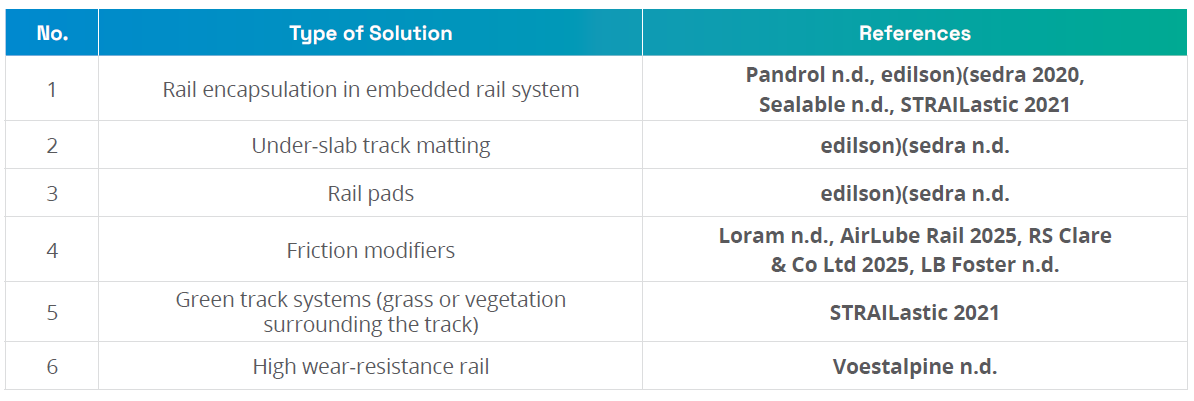
A desktop review of commercially available infrastructure solutions for mitigating noise and vibration in light rail systems identified six primary types of solutions (Table 1).
Table 1: Identified infrastructure-based solutions to reduce noise and vibration for light rail systems
3. Assessment of Solutions
To evaluate and compare solutions for reducing noise and vibration in light rail tracks, a multi-criteria assessment framework was applied. This process involves four key stages:
Defining the problem and assessment structure.
Assigning weights to evaluation criteria.
Scoring each alternative against the criteria.
Calculating weighted scores based on criterion importance.
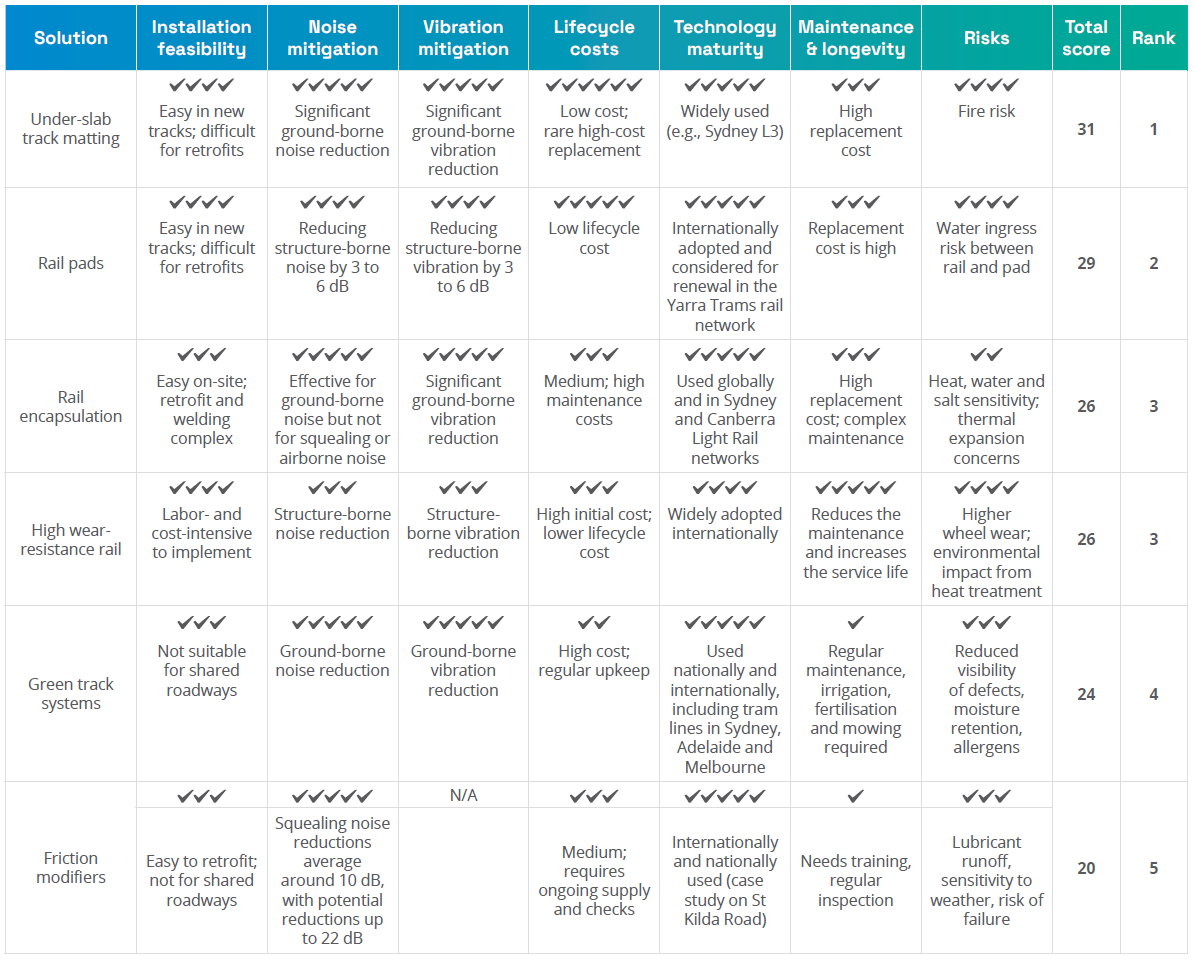
In this study, all criteria were equally weighted. Each solution was rated on a scale from 1 (least desirable) to 5 (most desirable) across the following categories:
Installation feasibility. The ease of installing the system, the extent of disruption to operations/general traffic during installation, and the requirements of the machinery used in installation (such as power, water, etc.)
Noise mitigation. A relative assessment of how effective the solution is at mitigating noise.
Vibration mitigation. A relative assessment of how effective the solution is at mitigating vibration.
Lifecycle costs. A qualitative assessment of how costly the option is, including the purchase of materials, installation, maintenance and decommissioning compared to other solutions.
Technology maturity. The extent to which the solution has been used or tested in Australia or internationally.
Maintenance and longevity. How extensive the maintenance requirement of this solution is and how long the system will last before needing to be replaced.
Risks. An assessment of any potential safety risks to pedestrians and vehicles (e.g. flange gap risk, fire resistance).
Table 2 presents the comparative results of the various mitigation solutions.
Table 2: Assessment of solutions
Comparing the solutions based on their ranking, under-slab track matting ranks the highest with a score of 31, standing out for its significant noise and vibration mitigation, low cost and suitability for new tracks. However, it is less ideal for retrofitting due to installation complexity and high replacement costs. Rail pads scored 29 and ranked second in the assessment, offering strong noise and vibration reduction with low costs, though their use in existing tracks is limited by installation challenges and risks such as water ingress. Rail encapsulation and high wear resistance rail ranked third with a score of 26. High wear resistance excels in lifecycle cost reduction and maintenance benefits but involves high initial costs and labour-intensive installation. Rail encapsulation significantly reduces ground-borne noise and vibration and offers the benefit of a low initial cost; however, repairs are costly and challenging.
Green track systems ranked fourth with a score of 24, as these provide environmental benefits but require extensive maintenance and are unsuitable for mixed rail traffic. Friction modifiers were the lowest ranked option, with a score of 20, as although they are easy to install on existing tracks and offer significant squeal noise reduction, they require regular maintenance, have a high environmental sensitivity, while the potential for lubricant run-off reduces their practicality.
4. Guidance
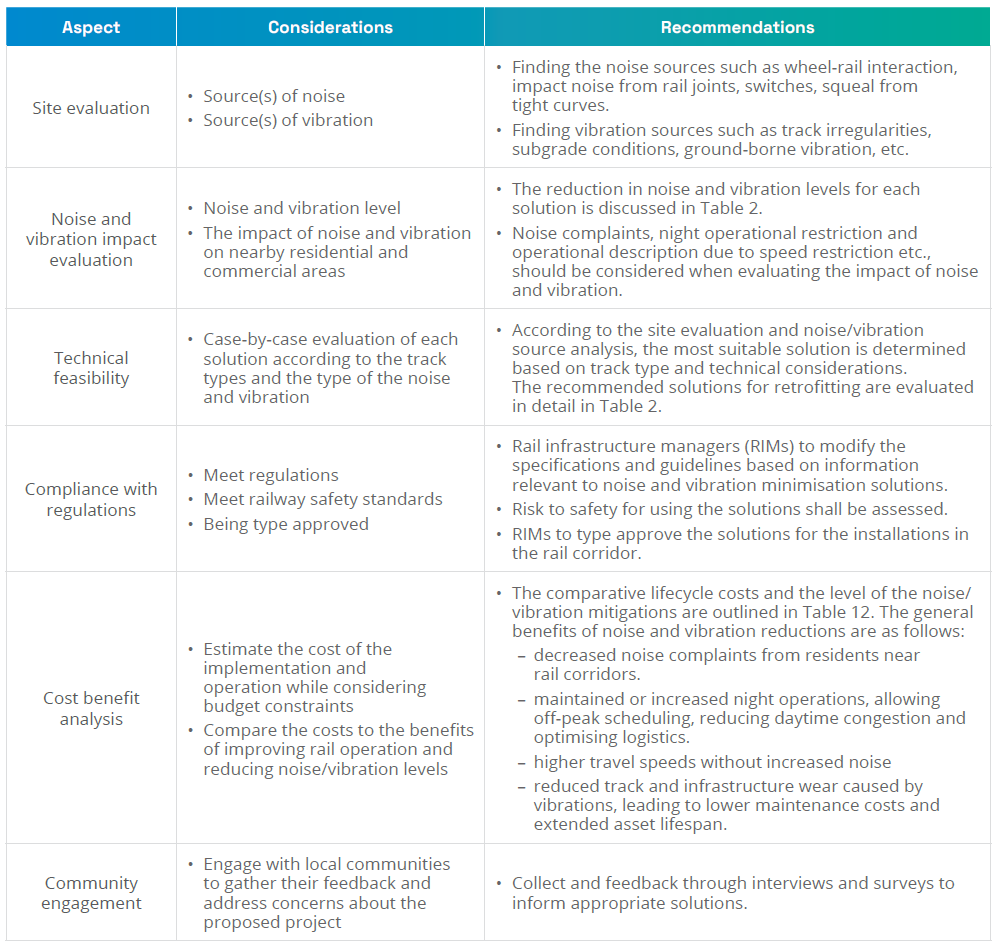
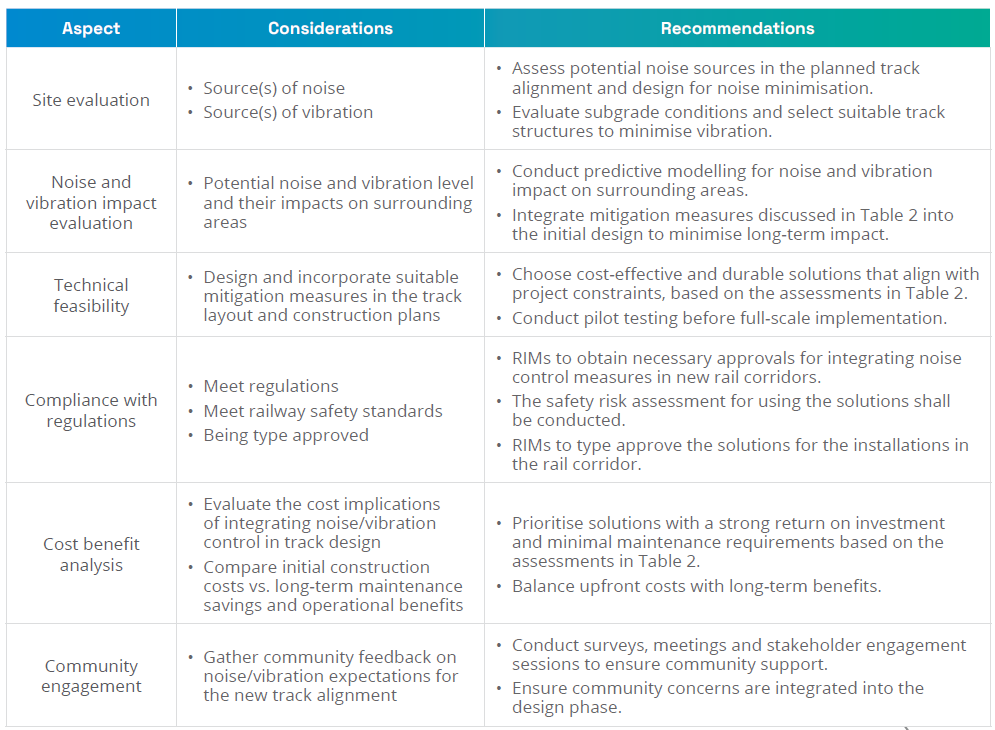
The next step is to ensure the key considerations are made for performing a feasibility assessment of the solution. Table 3 presents a detailed analysis for implementing the most practical rail noise and vibration mitigation solutions trial in existing rail track, including necessary considerations and relevant recommendations for each key aspect based on the review of literature and stakeholder consultation. For installation in new track systems, the key aspects, considerations and recommendations for implementing rail noise and vibration mitigation measures are outlined in Table 4.
Table 3: Feasibility analysis for installation of infrastructure solutions in existing track systems
Table 4: Feasibility analysis for installation of infrastructure solutions in new track systems
5. Conclusions
Each light rail mitigation solution was evaluated through a multi-criteria assessment framework, considering installation feasibility, mitigation effectiveness, lifecycle cost, maintenance requirements and associated risks. Stakeholder engagement was conducted to validate and enhance the findings derived from the desktop review. The assessment outcomes can be used to support decision-making for upgrades and future planning in noise and vibration sensitive light rail environments:
Under-slab track matting emerged as the most effective solution for noise and vibration mitigation. However, its installation in existing tracks poses significant challenges.
Rail pads are cost-effective and commonly used to address structure-borne noise and vibration. Contrastingly, they are vulnerable to water ingress.
Rail encapsulation demonstrated strong performance in mitigating ground-borne noise and vibration but is hindered by complex maintenance and repair requirements.
High wear-resistant rails offer moderate noise and vibration reduction, along with substantial lifecycle cost savings and maintenance advantages. These benefits are offset by high upfront costs and labour-intensive installation.
Green track systems contribute positively to urban integration and environmental aesthetics while providing noise and vibration mitigation. Nonetheless, they demand intensive maintenance and are less suitable for mixed traffic conditions.
Friction modifiers effectively reduce squeal noise and are easy to apply on existing tracks. However, their sensitivity to weather, potential for lubricant runoff and elevated risk of failure, limit their practicality for long-term use.
References
AirLube Rail 2025, Top of rail: Keltrack® Friction Modifier, AirLube Rail website, Malaga, WA, accessed 24 March 2025, <https://airlube.com.au/lb-foster-applicators/top-of-rail/>.
edilon)(sedra 2020, Corkelast® VA-40, technical document, Haarlem, The Netherlands.
edilon)(sedra n.d., Trackelast®, edilon)(sedra website, Haarlem, The Netherlands, accessed 24 March 2025, <https://www.edilonsedra.com/system/tracklast/>.
Hosseinzadeh, S, Merve Ürkmez, Z, Vink, E, Heeres, O, Schulz, G & Maftei, G 2024, ‘Prediction of light rail transit vibrations and vibration-reducing measures’, International Conference on Transportation Geotechnics (ICTG), 5th, 2024, Sydney, New South Wales, pp. 281-89.
Kouroussis, G, Zhu, S & Vogiatzis, K 2021, ‘Noise and vibration from transportation’, Journal of Zhejiang University-SCIENCE A, vol. 22, no. 1, pp. 1–5, doi: 10.1631/jzus.A20NVT01.
Loram n.d., Gauge face curve lubricant, Loram website, Hamel, MN, USA, accessed 25 March 2025, <https://loram.com/inspection-and-optimization/friction-management/friction-modifiers-and-curve-lubricants/gauge-face-curve-lubricant/>.
McIntosh, S 2015, ‘Is LRT really the noisy neighbour?’, Tramways & Urban Transit, vol. 78, pp. 109–135.
Pandrol n.d., QTrack: sustainble resilient systems, product information sheet, Pandrol, Colombes, France, accessed 25 March 2025, <https://www.pandrol.com/wp-content/uploads/2020/10/QTrack-Product-Information-Sheet-EN.pdf>.
RS Clare & Co Ltd 2025, Top of rail friction control material, RS Clare website, Liverpool, UK, accessed 25 March 2025, <https://www.rsclare.com/our-markets/rail-friction-management-solutions/top-of-rail-friction-modifier>.
Sealable n.d., Rail comfort system: the elastic rail encapsulation, Sealable website, Waltershausen, Germany, accessed 25 March 2025, <https://seal-able.com/rail-comfort-system-en>.
Sun, W, Thompson, D, Toward, M & Zeng, Z 2020, ‘Modelling of vibration and noise behaviour of embedded tram tracks using a wavenumber domain method’, Journal of Sound and Vibration, vol. 481, doi: 10.1016/j.jsv.2020.115446.
Voestalpine n.d., 400GHT® Track performance as design criterion, Voestalpine website, accessed 28 March 2025 <https://cdnstorevoestalpine.blob.core.windows.net/image-container/848939/original/RailSys_datasheet_Urban_Traffic_Tram_400GHT_2022-02_Rv4.pdf >.