Discover how container triangulation can significantly reduce truck movements, alleviate congestion, and enhance efficiency in Australia's freight supply chain.
Container Triangulation
Minimising truck vehicle kilometres travelled (VKT) associated with the relocation of empty containers (ECs) is essential for alleviating traffic congestion. Container triangulation presents a viable solution in this endeavour. It curtails landside container transport movements by enabling the direct transfer of import containers to export use, bypassing the necessity to route them through or transport them to an EC park.
1. Understanding the Problem
The import and export of goods as part of Australian trade requires the movement of shipping containers to and from shipping ports to warehouses and distribution centres across Victoria and Australia as part of the freight supply chain.
After a business unloads a full container, it becomes an EC and is transported to an EC park for storage. The original import business or another business can then use the EC to export goods. Alternatively, the EC can be transported to the port and shipped as an EC. Dedicated EC parks play a significant and unique role in the Australian logistical supply chain due to the imbalance of imports over exports. Further, landside inefficiencies associated with the movement of ECs to and from EC parks add significant costs to the logistical supply chain. Inefficiencies in the landside freight supply chain contribute to unproductive truck movements, which contribute to congestion, air pollution, and noise with minimal productivity benefits.
The magnitude of the inefficiency varies for different cities across Australia. For a city like Melbourne, this is somewhat exacerbated as the warehouse and distribution centres can be located across the Greater Melbourne area, with the EC parks located primarily close to the Port of Melbourne (PoM) and in the inner-western local government areas (LGAs) of the City of Melbourne, Hobsons Bay, Brimbank and Maribyrnong. Contributing to some of the landside inefficiencies is that many EC parks may be owned by the shipping lines, who may direct their ECs to their EC parks, which may be congested and/or experiencing service-related delays (NineSquared 2021).
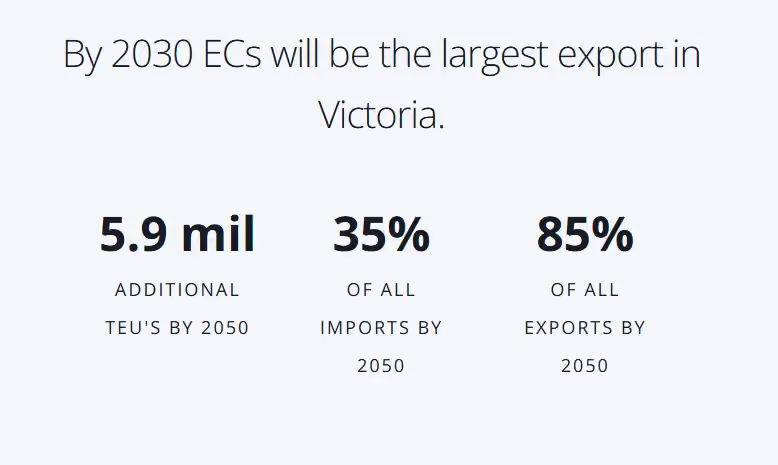
To give an appreciation of the quantities and potential growth in movements associated with container transport, the NineSquared (2021) strategic review of the Victorian EC supply chain noted that the PoM anticipates that container freight demand will grow from 3 million, twenty-foot equivalent units (TEUs) in 2019, to 8.9 million TEUs in 2050. The import and export of ECs will grow from 23% of all imports/exports in 2019 to 35% by 2050, with over 85% associated with the export of ECs. By 2030-31 it is predicted that ECs will be the largest export in Victoria.
Due to the magnitude of the number of TEUs being moved through the PoM, the truck traffic associated with the PoM (2020) is expected to increase from 11,000 per week to between 24,000 and 34,000 per week by 2050. The magnitude of this shift would depend on how many container movements could be shifted to rail. The movement of trucks associated with the PoM, particularly the movement of ECs, contributes to congestion of the road network.
2. Reducing Truck Movements Through Container Triangulation
Container triangulation offers a strategic solution to streamline the handling of containers on the landside. It empowers importers/exporters to either repurpose a container from imports to exports or directly swap ECs with another business. This can be accomplished by having importer/exporter businesses directly engage with each other instead of relying on third-party transactions and requiring goods to pass through the EC park. This helps address some of the inefficiencies on land. It can result in reduced transit times and handling associated with the EC.
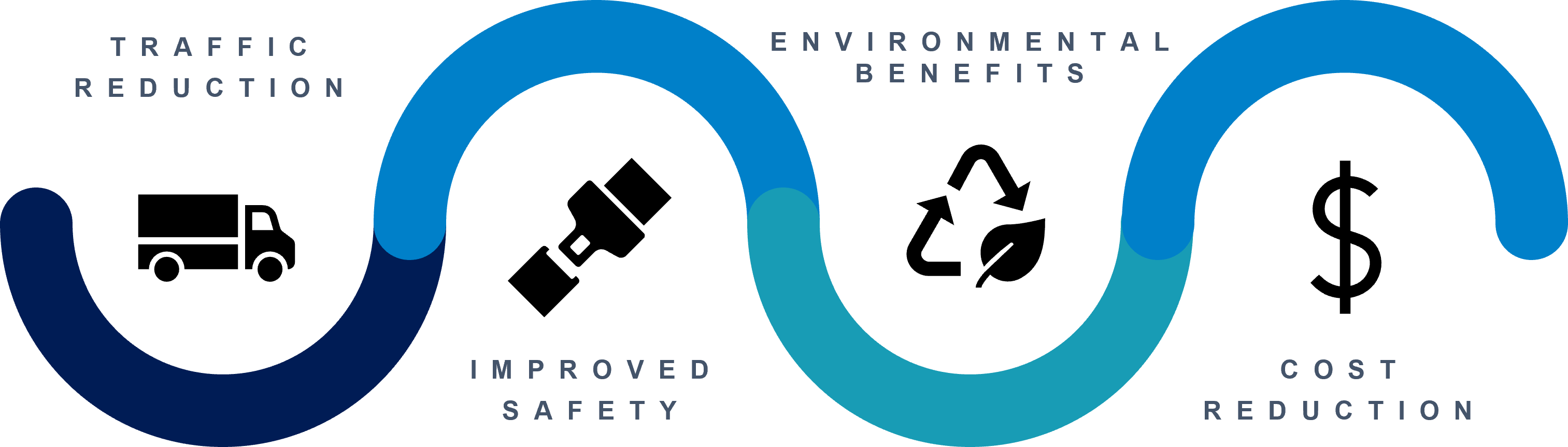
While this can benefit importers/exporters, it can also lead to societal benefits through:
- Reduced truck traffic and network congestion.
- Reduced freight interactions with other road users, improving road safety.
- Environmental benefits associated with the landside management of ECs.
- Improved efficiency in the landside management of goods shipped to and from Australia.
By way of example, a 2018 simulation model study (Irannezhad, Prato & Hickman 2018) found that triangulation had the potential in just 2 weeks to reduce 4,468 unnecessary trips for 277 shipping lines operating out of the Port of Brisbane (PoB). This results in transport cost savings of over 40%. Translating this to a full year could potentially see a saving of 116,618 trips saved. Since 2018, the PoB has seen notable growth, therefore it is expected that potential trip savings would have also grown. In addition, as PoM is Australia’s busiest container port, it is anticipated that the potential for trip savings would be even larger for PoM.
Road network managers, particularly those concerned with mitigating congestion and minimising environmental repercussions, should take note of the potential advantages associated with container triangulation. This method has the capability to address inefficiencies inherent in landside container management and lessen congestion and environmental impacts stemming from container movements.
3. Matchbox Exchange
Container triangulation requires an ability for businesses to be able to connect to one another and to coordinate the exchange of the container in a managed and coordinated manner. This includes the need for an ability to transfer documentation and responsibility for the container.
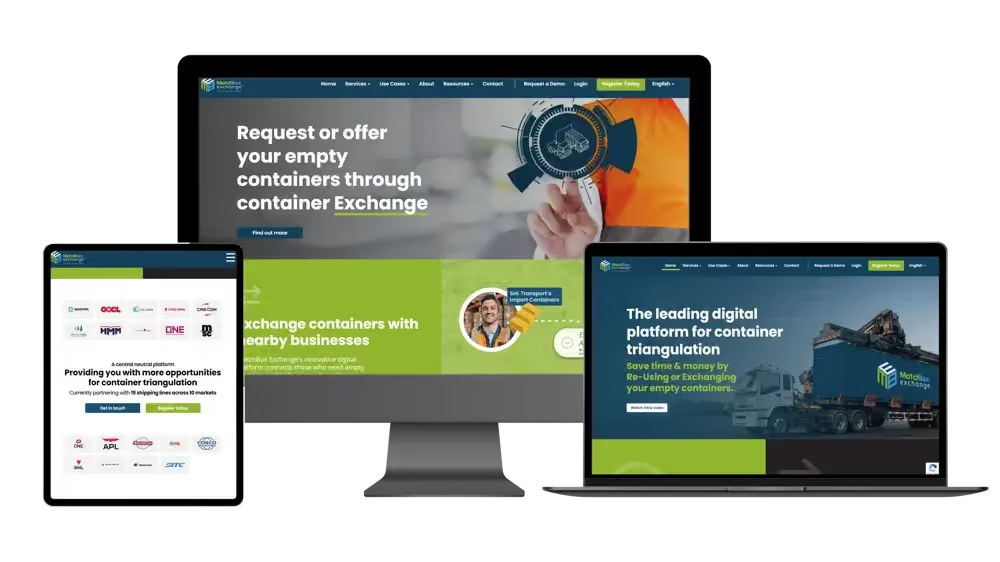
Matchbox Exchange (https://matchboxexchange.com/) is one such platform that provides a mechanism to implement container triangulation, enabling the ability for the importer/exporter businesses to:
- Directly reuse an import container to export goods.
- Connect with another importer/exporter business, exchange details and responsibilities about the containers, and ultimately transport and offload the container to another business with a reduced transportation cost compared to taking the EC to an EC park.
Matchbox Exchange can obtain insights into the participating businesses' ECs and look for opportunities that benefit the industry. These benefits can then indirectly benefit society through a reduction in truck VKT associated with the movement of ECs on the road network.
Matchbox Exchange (2024a) operates across Australia and reported a year-on-year growing increase in the number of EC triangulations being performed through their platform. Depending on the exchange, this has the potential to:
- Eliminate the need for a truck trip, as the triangulation results in the same business reusing the container from import to export.
- Reduce the VKT associated with the truck trip, where the triangulation results in the EC being used by a business located closer to the EC park.
Matchbox Exchange [1] has reported that for FY 2023/24, 26% of all triangulation bookings being undertaken across Australia were in Victoria and of these Victoria triangulations, 95% were undertaken in Melbourne. In Australia, 32% of all container triangulations were exchanged between businesses, while in Victoria, it was 18%. The percentage of MatchBox Exchange container triangulations that were container Exchanges between two separate businesses per state were as follows:
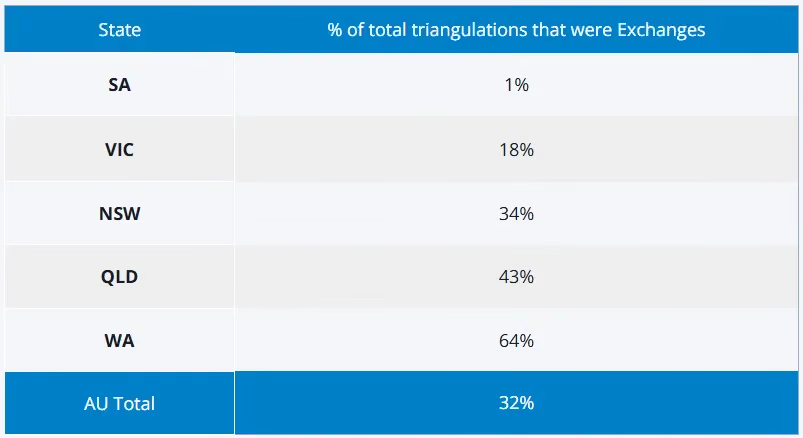
While 82% of the triangulations were associated with re-uses, there is significant potential to expand the number of the triangulations related to both re-uses and exchanges between businesses. A growth in re-use and exchange-based triangulations has significant potential to eliminate the need for truck trips to the EC parks and reduce the overall VKT associated with the movement of ECs.
The number of Victorian-based triangulations using Matchbox Exchange [1] is growing at an average rate of 32% per annum since its emergence in 2018. This indicates a significant opportunity for further growth and a significant opportunity to reduce further truck VKT associated with the movements of ECs.
4. Next steps
Road network managers have the opportunity to drive positive change by embracing solutions such as Matchbox Exchange. Solutions such as this enable importers/exporters to tackle inefficiencies in their logistical supply chain, resulting in cost savings. Furthermore, this can benefit society by reducing low-productive truck VKT and improving the overall operation of the road network, ultimately alleviating congestion.
It is essential for road managers to thoroughly evaluate the benefits of EC exchanges and utilise this insight to advocate for and facilitate its adoption among importers/exporters of shipping containers.
NTRO looks forward to the opportunity to work with road network transport managers to explore how platforms such as Matchbox Exchange can be used to achieve societal benefits through reduced truck VKT leading to reduced traffic congestion and reduced truck emissions (environmental impact).
5. Contact
Please feel free to contact David Green, Principal Professional within the Transport Futures portfolio of Asset Performance at the National Transport Research Organisation if you wish to discuss further.
References
- Irannezhad, E, Prato, CG, Hickman, M 2018, ‘The effect of cooperation among shipping lines on transport costs and pollutant emissions’, Transportation Research Part D: Transport and Environment, vol. 65, pp. 312-323.
- Matchbox Exchange 2024a, ‘Melbourne customer update’, PowerPoint presentation presented at CTAA / Matchbox Exchange Melbourne briefing, Yarraville Club, VIC, 18 April 2024.
- NineSquared 2021, Strategic review of the Victorian empty container supply chain, Department of Transport and Planning, Melbourne, VIC, accessed 13 June 2024 <https://content.vic.gov.au/sites/default/files/2023-09/Victoria-Empty-Container-Supply-Chain-Review-Copy.pdf>.
- Port of Melbourne 2020, 2050 Port Development Strategy: 2020 Edition, Port of Melbourne, Docklands, VIC, accessed 13 June 2024, <https://www.portofmelbourne.com/wp-content/uploads/PoM-PDS-2020-Edition-For-Publication.pdf>.
- [1] Matchbox Exchange provided statistics – 26 July 2024