E-micromobility Challenges and Opportunities: Research in Practice
The emergence of e-micromobility in Australia has been gaining momentum since the early 2010s, with its uptake surging in popularity during COVID-19 as people sought avoid public transport for social distancing purposes. By 2020, most major cities had, or were considering, shared/'for hire’ e-micromobility trials. This required all levels of government to seriously consider how best to regulate these new services to achieve the best public outcome from a safety and planning perspective.
This article was featured on NTRO on June 25, 2026
1. Introduction
The emergence of e-micromobility in Australia has been gaining momentum since the early 2010s, with its uptake surging in popularity during COVID-19 as people sought avoid public transport for social distancing purposes. By 2020, most major cities had, or were considering, shared/'for hire’ e-micromobility trials. This required all levels of government to seriously consider how best to regulate these new services to achieve the best public outcome from a safety and planning perspective. Similar to the challenges faced by the introduction of ridesharing, governments were faced with a contest in which technology was advancing faster than policy and regulation. It is therefore important to better understand the challenges and opportunities presented by this emerging mode of transport to ensure future policy directions are targeted and enable the potential of e-micromobility to be unlocked without detriment to urban planning and road safety outcomes.
2. Understanding the challenges and opportunities created by e-micromobility
The appeal of private and shared e-micromobility is undeniable, given its popularity as a convenient and cost-effective mobility solution. It has also garnered the attention due to regulations (and even bans) around its usage in various cities around the world. There are valid reasons for these bans that could be attributed to safety concerns due to the behaviour riders, and other road users, have exhibited in the use of these personal mobility devices. Emerging concerns around the use of private and shared e-micromobility can be broadly centred around three key factors:
Unsafe user behaviour during rides (e.g., joyriding, riding at high speed in shared areas, riding without a helmet or riding on roads and footpaths).
Unsafe behaviour of other road users around e-micromobility users (e.g. inattention/unawareness of drivers, higher vehicle speeds).
Negative urban planning outcomes caused by the parking or placement of the devices (e.g. footpath clutter).
2.1 E-micromobility: a threat to safe urban mobility?
Between 2020 and 2024, injuries involving e-mobility devices more than doubled in some Australian states and territories (Berecki-Gisolf and Hayman 2024). In 2025 alone, a 69-year-old man in Victoria was struck and killed while crossing the road by an illegally modified e-bike travelling at 80km/h (Bicycle Network 2025). In Perth, a 51-year-old man was struck and killed by a foreign student on an e-scooter travelling with over three times the legal blood alcohol content (Ho 2025).
In a recent NTRO submission to a WA Parliament inquiry on the use of e-rideable devices, the following safety challenges were discussed.
2.1.1 Increase in injuries relating to e-micromobility and liability
Health departments across Australia are recognising the severe impact that e-rideables are causing with regards to trauma patients presenting at hospitals. As an example, the Jamieson Trauma Institute launched the Electric personal MObility DEvices Surveillance (E-MODES) Patient Survey Study to better understand the true extent of the safety issue and its related costs to health departments, which is only possible through accurate case identification and thorough information recording (Vallmuur et al. 2023). To date, this remains the most comprehensive source of information regarding e-mobility injuries in Queensland.
The insurance landscape for e-micromobility usage in Australia remains complex and inconsistent (Polaris Lawyers 2022, Mini EVs n.d.). Traditional motor vehicle schemes, such as that offered by the Transport Accident Commission (TAC), typically exclude coverage for unregistered vehicles like e-scooters. Furthermore, personal insurance coverage varies considerably across jurisdictions and providers, with e-scooters sometimes classified as motor vehicles requiring motorcycle insurance and in other cases treated as low-powered bicycles. This lack of uniformity creates substantial uncertainty regarding liability and compensation following an accident. This underscores the pressing need for clearer, more comprehensive insurance frameworks to ensure adequate protection for all road users.
Local Government must be actively engaged and involved in the planning, delivery and management of e-micromobility initiatives, as they are predominantly used on local roads and streets that they are responsible for.
2.1.2 Usage of e-micromobility in dense, mixed traffic environments and urban precincts
The use of e-micromobility in dense, mixed traffic environments, including highly pedestrianised areas or other urban precincts, poses a significant road safety issue due to the conflicting mix of motorised vehicles and vulnerable road users such as pedestrians.
Complete separation through dedicated infrastructure is not always feasible or possible, so there needs to be rationalisation of the threshold of e-micromobility-volumes-to-pedestrian mix, which warrants investigating the need for dedicated infrastructure. There is a need to understand how to differentiate separation of infrastructure in highly pedestrianised areas, whereby streets provide an environment for people to congregate and dwell (also referred to as streets with ‘high place significance’). This also involves ensuring adequate end-of-trip facilities, such as parking, are provided in a way that ensures undesirable and unsafe kerbside clutter is avoided.
2.1.3 Compliance and classification of e-micromobility devices
The previous sections outline genuine and emerging issues that warrant further investigations on the best approach to regulate the use of e-micromobility devices and, equally importantly, the policing and enforcement of these regulations. Similarly, compliance and associated enforcement of e-micromobility is two-fold:
Compliance of rider behaviour – ignorance of the law is no defence; being unaware of regulations and user responsibilities are not acceptable reasons to justify dangerous use of e-micromobility. However, governments can do more to consider how critical information around the safe use of e-micromobility is conveyed to the public through improved education, awareness campaigns and information/signage to encourage improved behaviour.
Compliance of the device – understanding what types of e-micromobility devices are permissible under current jurisdictional legislation and how to police the illegal modification and import of non-compliant devices into the market.
This can be challenging when the regulatory frameworks governing the use of e-micromobility are unclear and data supporting the use of these modes of transport is not easily monitored and reported on.
2.2 The benefits offered by e-micromobility
It is not all bad news; there are many opportunities and important benefits that e-micromobility can deliver to the community when used responsibly and safely.
Jurisdictions such as NSW have been tackling the challenge of ensuring the safe usage of e-micromoblity on their road networks. In October 2024, Transport for NSW (2024) published their E-micromobility Action Plan that outlines key opportunities that are, and can be, unlocked by this mode of transport. The Action Plan outlines how permissible e-bikes can be safely used on public roads (noting that private e-micromobility is still only legal for use on private property in NSW).
The notion of a ‘15-minute city’ is an emerging concept in urban planning that can be enabled by the creation of multiple, distinct hub-and-spoke centres. To support this vision, e-micromobility has the potential to be a solution to fill the first- and last-mile gap, to ensure effective public transport integration.
From a sustainability perspective, an increased use of e-rideables will result in overall reduction in carbon emissions by creating a mode shift from private vehicles to active transport. Like any form of active travel, e-rideables are not subject to congestion, fuel or registration costs, providing added economic benefits as a cost-effective transport alternative.
Electric personal mobility aids, which could be categorised as a subset of e-micromobility, provide an opportunity for people with various accessibility needs, which are not able to drive as an example, to have equal access to employment, education, healthcare and wider community life.
To unlock these opportunities and benefits, the emerging road safety challenges outlined previously must be tackled in earnest, by both public and private sector transport and planning practitioners.
3. E-micromobility challenges and opportunities in practice
To better understand the motivations for the use of e-micromobility, and test some of the challenges and benefits outlined in Section 2 in practice, the NTRO rolled out the Shared E-micromobility Staff Pilot Program at the head office in Port Melbourne. This project was co-funded by Fishermans Bend Innovation, Diversity, Experimentation and Activation (FB IDEAs), with microFleet as the supplier partner.
The pilot program broadly involved:
A run period between February and June 2025.
The provision of 2 e-bikes and 2 e-scooters for NTRO staff to use.
Devices that could be used for any trip purpose and even borrowed overnight for commuting trips.
Participants signing a user agreement and procuring an appropriate rider insurance to be able to register.
Pre-trip checklists completed and recorded in Donesafe safety compliance platform.
During the pilot program, there were two data collection activities. Firstly, geolocation data was collected from the e-micromobility devices that provides information on the trips made. Secondly, a staff survey was conducted to collect insights into the perception of staff members on the trial, as well as to understand their behavioural decision on their mode choices and participation in the trial. The survey collected responses for two weeks in July. There were 36 responses received, six of which were from users of the devices.
3.1 Findings from the program
The project resulted in three major learnings. These learnings are on: (i) the safety challenges in establishing such operation; (ii) analysis of the usage patterns; and (iii) the findings from the staff survey.
3.1.1 Safety is at the centre of everything
The project found t three key aspects of safety when establishing such a program, namely: facility safety; vehicle safety; and rider safety.
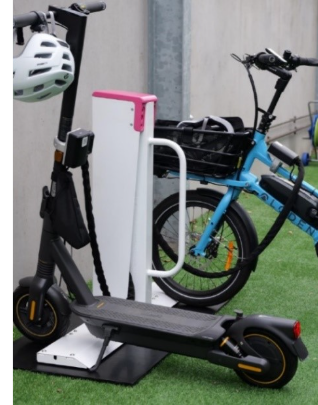
Figure 1. NTRO E-Micromobility
Facility Safety. This aspect relates to the measures taken to manage the safety risk if a fire occurs due to the e-micromobility devices and the charging equipment. This aspect determines the storage location of the e-micromobility devices and equipment, depending on the fire isolation, proximity to the appropriate fire extinguishers, evacuation path and any other existing safety requirements. Additionally, the building owners may have guidelines/requirements related to electric vehicle charging, which need to be adhered to.
Vehicle Safety. To ensure the safety of the e-micromobility device, it needs to comply with relevant safety standards, particularly those related to the battery and the charger. Additionally, a pre-trip safety check (e.g., brake and tyre check) needs to be done before every trip to ensure the device is suitable for use. Finally, regular maintenance of the devices needs to be carried out and appropriate insurance is required to cover any damages to the device.
Rider Safety. The current regulatory framework on e-micromobility relies on each user’s responsibility to do the right thing, such as following the road rules, riding responsibly and ensuring their riding skills are appropriate. For this, a user agreement was professionally drafted to ensure clear and well-defined roles and safety responsibilities. Additionally, trips on e-micromobility devices are not covered under Workcover. ‘For hire’ schemes, including the NTRO E-micromobility Staff Program, rely on riders’ insurance from a reputable provider to cover any injuries or damages due to incidents involving the use of e-micromobility devices.
Our experience from the program provides a glimpse into the potential mechanisms to better enforce compliance, mainly through technology. The NTRO e-micromobility devices are equipped with GPS trackers, from which trajectory data can be extracted, which provides some insights into the device movements. Coupled with appropriate booking and user account systems, such frameworks can potentially be used to monitor user behaviour and act accordingly if any non-compliance to road rules is detected. There is still work to be done to further develop and test various technologies for such use, e.g., understanding the impact of GPS accuracy on the accuracy of movement monitoring.
3.1.2 Use cases: short commute or recreational trips
There were six unique users who made a total of 55 bookings, with two regular users contributing 87% of those bookings. Of those 55 bookings, 53 were overnight bookings used to commute from/to work (plus the occasional trips to other activities such as shopping). Furthermore, looking at comparisons with other modes (Table 1), e-micromobility devices offer a better travel option when compared to public transport. However, the travel times by private car are much shorter on both trips, specifically for User 1. This highlights that e-micromobility is more suited to shorter trips. Finally, it is worth noting that these two users were active transport users.
Table 1: Comparison of the taken e-micromobility trips with other modes
These findings indicate that e-micromobility option is more likely to be competitive for commuting over a relatively short distance. Unfortunately, the project also finds that e-micromobility is more likely to replace active transport rather than cars, as evidenced by the fact that the regular users of this program were already active transport users. This aligns with a recent study in Poland that found that e-bike sharing schemes mostly replace public transport, not car trips (Bieliński et al. 2021). Combining this with the fact that e-micromobility is inherently less active compared to active transport modes (Payne et al. 2025), our findings point to the need to have a more careful deployment strategy to ensure better transport outcomes.
3.1.3 Potential detractors
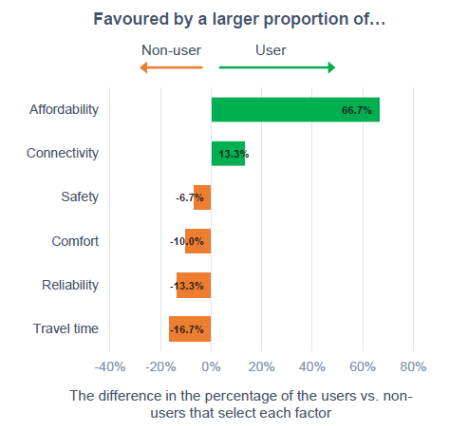
The staff survey collected a cross-sectional data on perceptions of the e-micromobility option for their trips. Firstly, the top six factors influencing the respondents’ mode choice were travel time, reliability, connectivity, affordability, comfort and safety. Non-users tended to favour travel time, reliability, comfort and safety, whereas users were more likely to consider affordability and connectivity as important (Figure 2). This further reveals the appeal of driving in addition to trip time, which is the perceived safety, comfort and reliability.
Figure 2: Difference in the important of factors affecting mode choice between users vs. non-users. Source: NTRO analysis
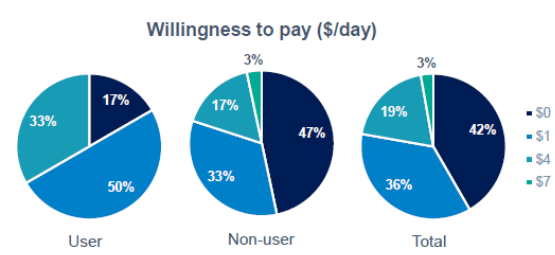
Secondly, it was found that the top three most common reasons for not participating in the trial were: unwillingness to pay for insurance; there being no need to use the e-micromobility option; and there being interest but no usage (i.e., there was no urgency to use e-micromobility). Digging deeper into the issue of cost, it was found that the maximum daily cost the respondents are willing to pay was relatively low (Figure 3).
Figure 3: Willingness to pay for the use of e-micromobility. Source: NTRO analysis
4. Concluding remarks
The trial revealed the many challenges associated with establishing a widely adopted staff e-micromobility sharing program. The legal requirements and the attractiveness of other modes, such as private cars, have proven to be hurdles that need to be overcome before we see widespread adoption of e-micromobility devices. To combat this, more support from employers may be required to help drive uptake, e.g. by providing financial support for the insurance costs and a more streamlined process (e.g., automated documentation). More generally, transport networks in many Australian cities are still geared for car travel. As such, the attractiveness of active transport is generally lacking when compared to private car use and there is inadequate justification to switch to active transport modes.
The rise in injuries, inconsistent insurance coverage, as well as regulatory ambiguity, all underscore the urgent need for robust policy frameworks and infrastructure planning. While e-micromobility presents significant opportunities for enhancing urban mobility, sustainability and accessibility, its integration into existing transport systems demands careful and coordinated action. Broader industry practitioners from other sectors such as local government, health departments, law enforcement and private industry, must also come to the table, alongside transport agencies, to address safety concerns, ensure compliance and educate the public on responsible usage.
Only through comprehensive regulation, thoughtful urban design and inclusive planning, can the full potential of e-micromobility be realised: delivering safer, cleaner and more equitable transport options for all members of the community.
References
Berecki-Gisolf, J & Hayman, J 2024, Injuries associated with e-scooters, e-bikes and other e-micromobility devices: analysis of Emergency Department presentations and deaths in Victoria, 2016 to 2023, Hazard Edition 93, Monash University, Vic.
Bicycle Network 2025, ‘Rider charged over modified e-bike death’, Newsroom, 1 July 2025, accessed 19 September 2025, <https://bicyclenetwork.com.au/newsroom/2025/07/01/rider-charged-over-modified-electric-bike-death/>.
Bieliński, T, Kwapisz, A & Ważna, A 2021, ‘Electric bike-sharing services mode substitution for driving, public transit, and cycling’, Transport and Environment, vol. 96, doi: 10.1016/j.trd.2021.102883.
Ho, C 2025, ‘Perth man Thanh Phan dies after being hit by e-scooter in alleged drunken crash’, ABC News, 3 June 2025, accessed 19 September 2025, <https://www.abc.net.au/news/2025-06-03/thanh-phan-dies-after-being-hit-by-e-scooter-in-perth-cbd/105370284>.
Mini EVs n.d., Navigating insurance and liability for electric scooters, Mini EVs website, accessed 19 September 2025, <https://minievs.com.au/navigating-insurance-and-liability-for-electric-scooters/>.
Payne, C, Smith, SA, Sappal, A, Boorgula, R & Taylor, KA 2025, ‘Are e-scooters active transport? Measured physical activity outputs of e-scooter riding vs walking’, Journal of Transport & Health, vol. 41, doi: 10.1016/j.jth.2024.101963.
Polaris Lawyers 2022, E-scooters – who pays compensation when someone is injured?, Polaris Lawyers website, accessed 19 September 2025, <https://www.polarislawyers.com.au/legal-compass/e-scooter-accidents>.
Transport for New South Wales 2024, E-micromobility action plan, TfNSW, NSW.
Vallmuur, K, Mitchell, G, McCreanor, V, Droder, B, Catchpoole, J, Eley, R & Smyth, T 2023, ‘Electric personal MObility DEvices Surveillance (E-MODES) study: Injury presentations to emergency departments in Brisbane, Queensland’, Injury, doi: 10.1016/j.injury.2023.04.036.